This week, Snowflake eliminated its entire technical writing team — roughly 70 people across the documentation division. Not reduced. Not restructured. Eliminated. The company will no longer use human authors for its documentation. The cuts came weeks after CFO Brian Robbins told analysts on the Q4 FY2026 earnings call that “AI has really changed the framework for investing in growth — no longer tied to headcount.”
The cut was part of a broader ~200-person reduction in force disclosed that quarter. The affected writers spanned multiple product teams, including Streamlit, Snowflake’s open-source Python framework for building data apps. These were not narrow-scope documentation roles. The writers were embedded with engineering teams, contributing to platform engineering, developer tooling, and AI workflows alongside the engineers building the products. The team had been advocating for additional headcount to cover growing documentation needs — instead, the entire function was cut.
The decision to zero out documentation says something specific about how Snowflake values the work that sits between what engineers build and what customers actually use.
The Business Case Against Cutting Docs
The 2026 State of Docs Report quantifies what most enterprise software buyers already know: documentation is part of the purchase decision. 80% of buyers review documentation before purchasing. 88% say it influences their decision. 51% say it is essential to closing deals.
Snowflake spent approximately $1.66 billion on sales and marketing in FY2026 — 35.4% of its $4.68 billion in revenue, per its earnings release. That’s the cost of getting enterprise buyers to the table. Documentation is what those buyers read when they’re at the table. Eliminating the team that writes it doesn’t reduce the sales funnel — it removes a stage from it.
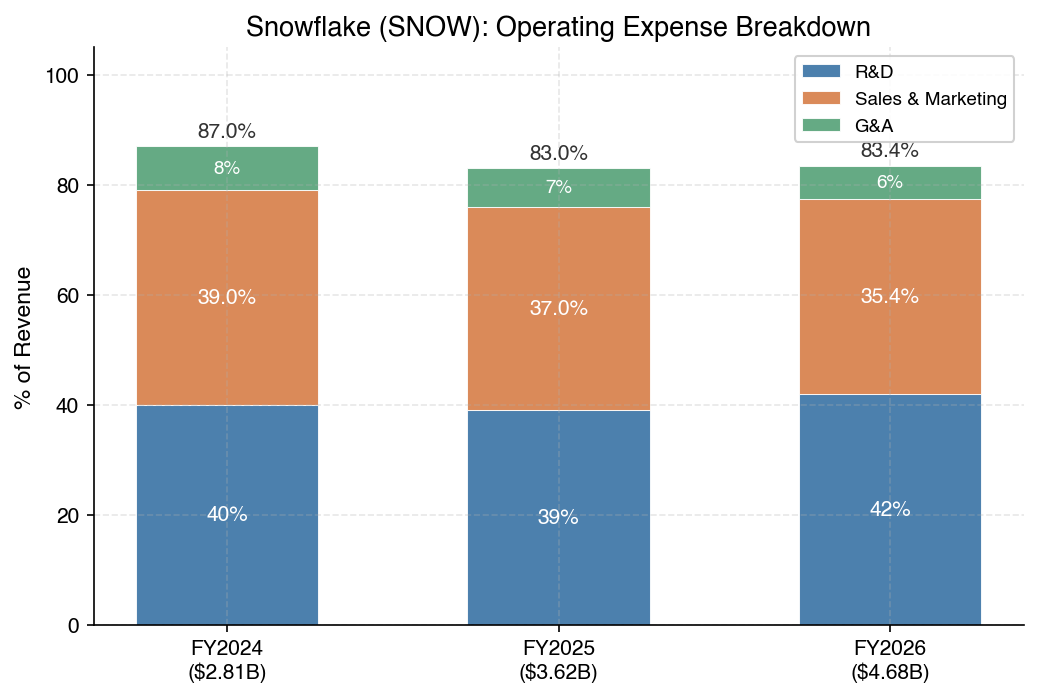 Snowflake’s operating expense breakdown, FY2024–FY2026. Sales & marketing dominates spend at 35% of revenue. Data from SEC EDGAR and earnings releases.
The AI Substitution Bet
The implicit logic is that AI can replace technical writers. Snowflake’s own research, conducted with Omdia, found that 48% of code at surveyed companies is now AI-generated. If AI can write code, the reasoning goes, it can write documentation.
This conflates two different kinds of work. Code generation operates within formal systems — syntax, types, APIs with defined inputs and outputs. Documentation translates those formal systems into human understanding. It answers the question a developer asks at 2 a.m. when the error message is useless and the Stack Overflow thread is three years stale. That translation requires judgment about what the reader doesn’t know. And when writers are embedded in the engineering process — contributing to tooling, automation, and product design — they’re not just documenting the product. They’re shaping how it’s understood. Replacing that function with AI isn’t automating documentation; it’s removing the people who understood the product well enough to explain it.
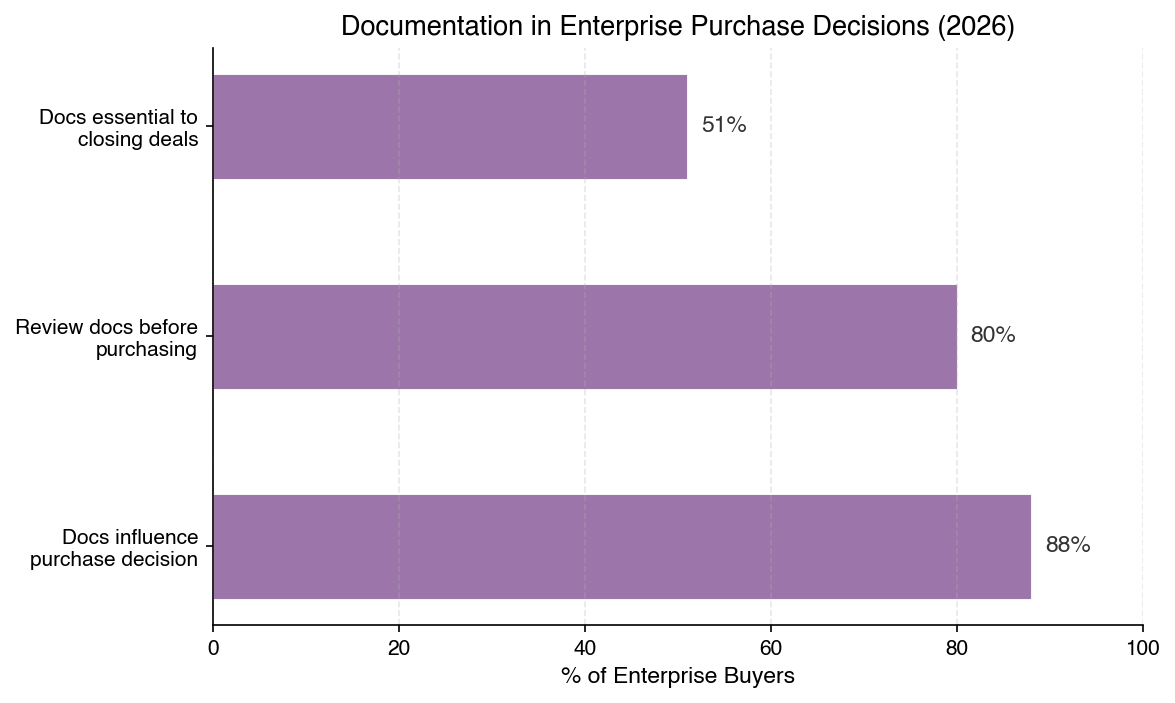 The role of documentation in enterprise purchase decisions. Data from the 2026 State of Docs Report.
The pattern is familiar. When companies eliminate documentation teams, engineers inherit the writing burden. The docs don’t disappear — they get worse, written by people whose primary job is something else. The cost doesn’t vanish; it redistributes, partly to engineers and partly to customers.
A Company Selling AI, Betting on AI
There’s an irony specific to Snowflake. This is a company whose growth depends on enterprises trusting it with their data infrastructure — a bet that requires understanding complex configuration, security models, and query optimization. The product’s value proposition is that it replaces fragile, poorly understood data systems with something coherent. The documentation is how customers verify that coherence.
Snowflake posted $4.68 billion in revenue for FY2026, up 29% year-over-year. Net revenue retention was 125%, meaning existing customers spent more. Remaining performance obligations hit $9.77 billion. By every growth metric, the business is working. The question is whether eliminating the team that explains the product to buyers is an efficiency gain or an unforced error on a long enough timeline.
The Broader Pattern
Snowflake is not alone. The tech industry has shed nearly 56,000 jobs in 2026 so far, per layoffs trackers, with AI cited as a factor in a growing share of cuts. Documentation, QA, and support roles — the functions that sit between engineering output and customer experience — are disproportionately represented.
The common thread: writers, QA engineers, and support staff are treated as the compressible layer between engineering and revenue. Adobe compressed SG&A from 13.1% to 6.6% of revenue by automating the customer relationship through subscriptions. AbbVie kept its commercial workforce intact because pharmaceutical sales resist automation. Snowflake is making a different bet — that the explanatory layer between product and customer can be automated away.
The 2026 State of Docs data suggests that bet is riskier than it looks. When 80% of your buyers check the docs before they buy, the documentation team isn’t overhead. It’s the last mile of the sales funnel.
There’s a deeper contradiction. Snowflake is betting its future on AI — Cortex AI, Document AI, agent frameworks, natural-language querying. Every one of those products depends on precisely written prompts, system instructions, agent definitions, and skill descriptions. This is a new kind of technical writing: not explaining software to humans, but explaining human intent to machines. The craft of structuring language so that an AI system behaves correctly is, at its core, a writing discipline. The companies building AI products may find they need writers more than ever — just not in the roles they eliminated.
Data Sources
- Corporate financials: SEC EDGAR — Snowflake Inc. 10-K filings
- Earnings call: Snowflake Q4 FY2026 Transcript — Motley Fool
- Documentation impact: 2026 State of Docs Report
- Layoff source: Affected employees, via LinkedIn
- AI code generation: Snowflake/Omdia research
- Industry layoffs: Tech Layoffs 2026 Tracker
- Analysis: Generated by AI (Anthropic Claude), reviewed by Stephen Sciortino