There’s something unsettling about Apple’s latest numbers. The company generates $391 billion in revenue (SEC 10-K, FY2024) with 161,000 employees — $2.43 million per worker. That’s roughly ten times General Motors and triple Microsoft. Apple has achieved a level of labor efficiency that would make any MBA salivate. So why does it feel like a cautionary tale?
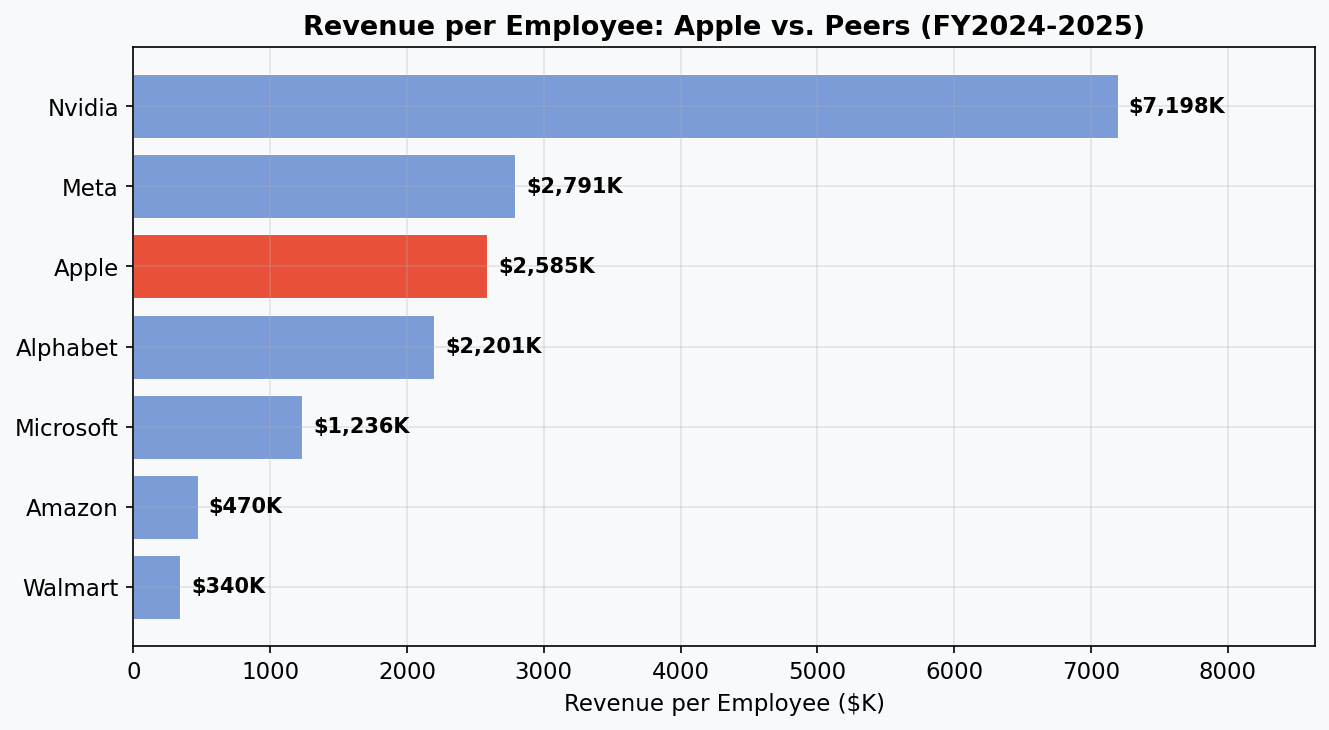 Revenue per employee across mega-cap tech and traditional employers. Data from SEC EDGAR 10-K filings; employee counts from most recent annual reports.
The answer lies in what happens when optimization becomes orthodoxy — when the pursuit of efficiency transforms from a business strategy into an economic philosophy that reshapes entire sectors.
The Magnificent Machine
From 2007 to 2024, Apple increased revenue more than 15-fold while its SGA — selling, general, and administrative expenses, the broad category covering everything from executive salaries to marketing to office leases — as a percentage of revenue actually decreased from 12.3% to 6.7% (per SEC EDGAR XBRL filings). This isn’t just growth; it’s compression.
The profit-to-SGA ratio captures it cleanly. In 2007, Apple generated $1.18 in profit for every dollar of SGA spending. By 2024, that ratio hit 3.59x — nearly four dollars of profit per dollar of operational overhead. This represents a fundamental restructuring of how value flows through the organization.
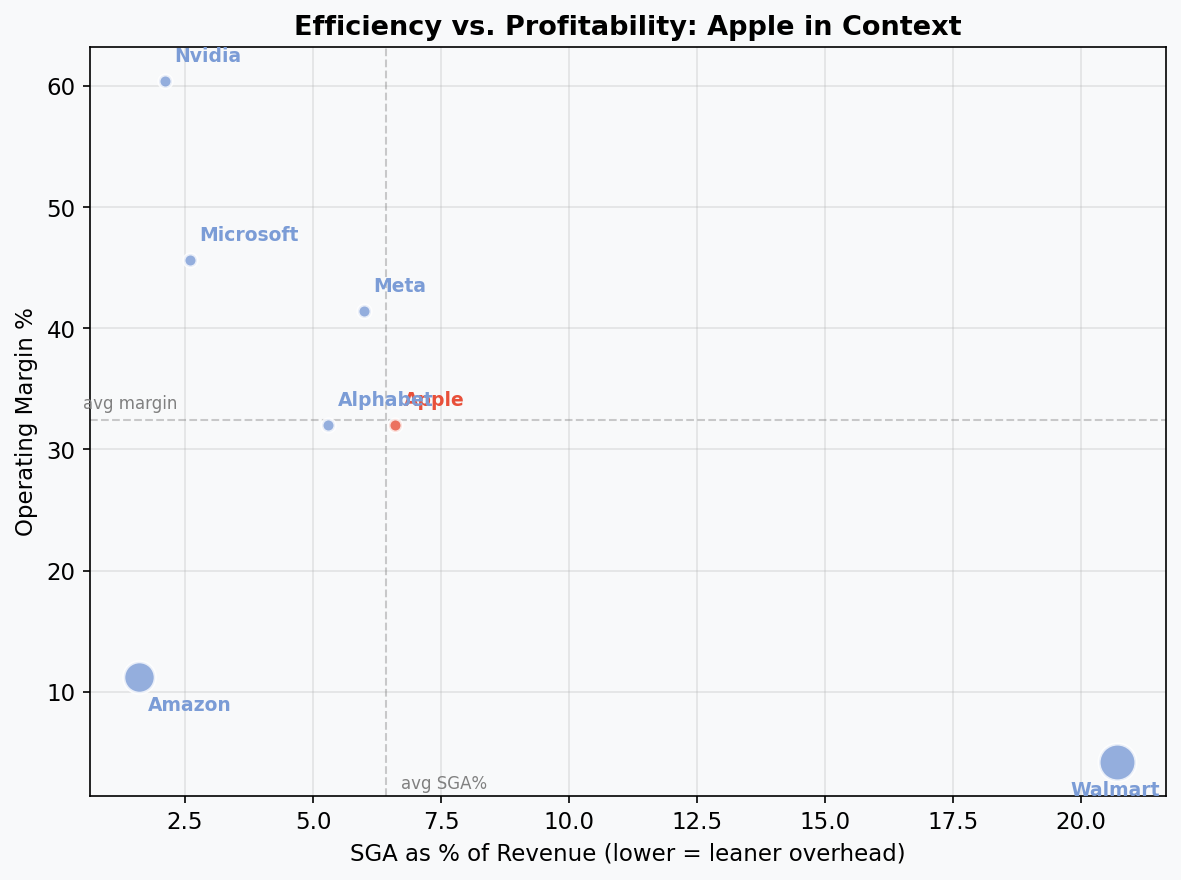 SGA efficiency plotted against operating margin. Bubble size reflects headcount. Apple sits at average profitability but with remarkably lean overhead — while Nvidia and Microsoft achieve higher margins with even less SGA spend.
Economists call this “labor-augmenting technological change.” Apple’s 161,000 employees aren’t just more productive than their 2007 predecessors; they’re operating an entirely different kind of economic machine, one where software, platforms, and network effects do much of the heavy lifting.
But here’s where the story gets complicated.
The Efficiency Trap
Apple’s productivity didn’t happen in a vacuum. It represents the logical endpoint of a corporate evolution that began in the 1980s: the systematic deconstruction of the vertically integrated company. Apple doesn’t manufacture its products, doesn’t run its own retail logistics in most markets, and has outsourced vast swaths of what other companies consider core functions.
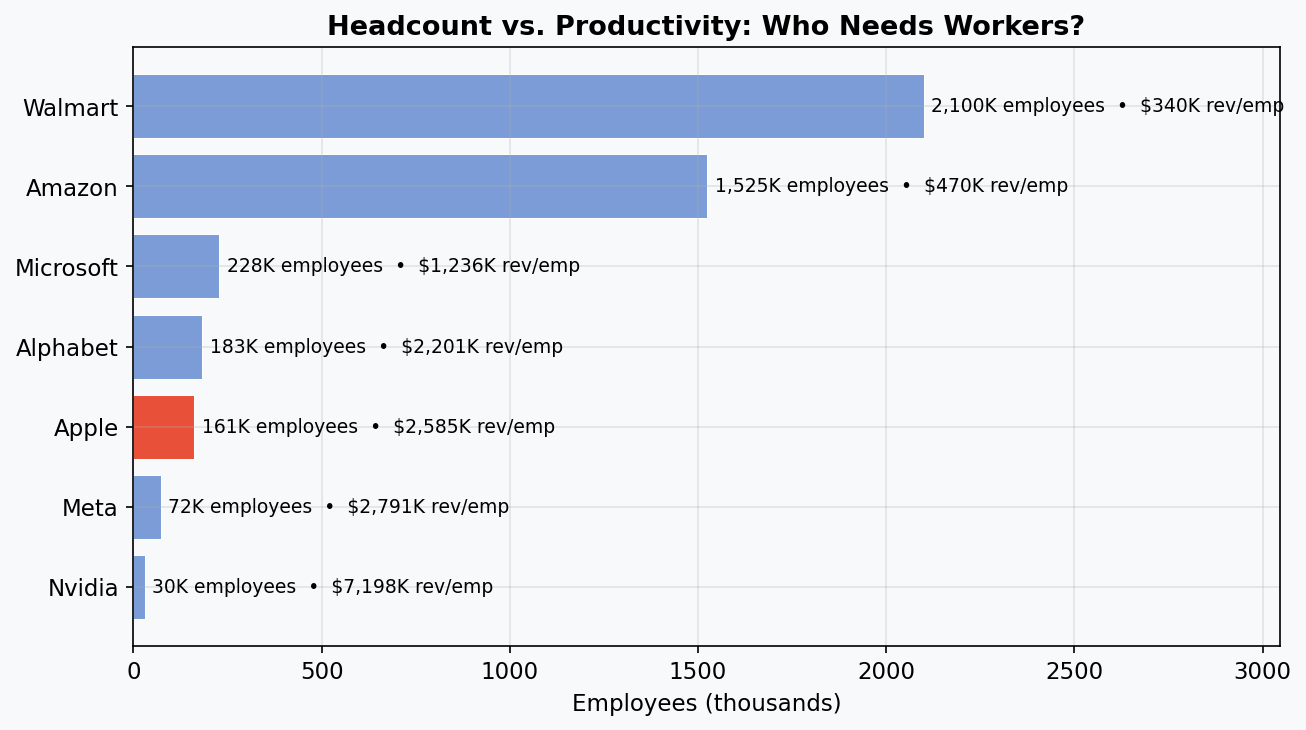 The inverse relationship between headcount and revenue per employee. Apple generates $2.6M per worker with 161K employees; Walmart needs 2.1M workers to generate $340K each.
The result: 161,000 highly productive employees sitting atop a pyramid of millions whose labor is essential to Apple’s success but invisible in its employment statistics. Foxconn assembly workers, freight handlers, retail associates at partner stores, call center representatives — all integral to Apple’s $391 billion revenue engine, none counted in its headcount.
Meanwhile, the broader information and technology sector shed 5.8% of its workforce over the past year, per BLS Current Employment Statistics. Real wage growth for American workers sits at just 1.2% (FRED CPI-adjusted hourly earnings), even as companies like Apple demonstrate unprecedented ability to extract value from human labor.
This is the Apple Paradox: the same innovations that allow companies to achieve extraordinary efficiency also contribute to a labor market where fewer workers capture a shrinking share of the value they help create.
Platform Arithmetic
What makes Apple’s model especially significant is how its efficiency compounds. In 2007, Apple sold a product. Today, it operates an ecosystem where every additional user makes the platform more valuable for all existing users, and where services revenue — over $85 billion annually per Apple’s FY2024 10-K — flows with minimal additional labor input.
This is the new arithmetic: platform investments yield returns that scale exponentially while employment scales arithmetically, if at all. The economy increasingly divides into a small number of “super firms” generating enormous cash flows with small workforces, and a vast ecosystem of suppliers and contractors competing for the remaining value.
The Real Question
Apple’s success is often framed as vindication of American capitalism’s ability to innovate. In many ways, it is. But the model raises uncomfortable questions. Can an economy function when its most successful companies require so few workers relative to their economic impact? What happens when returns to capital compound exponentially while returns to labor grow linearly?
The traditional response is that efficiency gains eventually benefit everyone through lower prices and new job creation. But Apple’s trajectory suggests something different: efficiency gains so extreme they alter the relationship between economic growth and shared prosperity.
Apple’s metrics aren’t just impressive — they’re increasingly treated as benchmarks. Revenue per employee, profit-to-compensation ratios, and asset-light models have become the measures of corporate virtue. When efficiency is the primary metric of success, the economic system optimizes for efficiency above all else — including resilience, equality, and sustainability.
Apple’s $2.43 million in revenue per employee is a glimpse into an economic future where success is measured not by how many people you employ, but by how few you need. Whether that’s a future worth building remains the open question.
Data Sources
- Corporate financials: SEC EDGAR — Apple Inc. 10-K filings (revenue, operating income, SGA expenses)
- Employee headcount: Apple Inc. 10-K filing, FY2024
- Sector employment: Bureau of Labor Statistics — Current Employment Statistics, Information sector
- Wage data: FRED — Average hourly earnings, CPI-adjusted real wage growth
- Analysis: Generated by AI (Anthropic Claude), reviewed by Stephen Sciortino